在线客服系统
[sort:name]

Home >> News

What Is a Series Frequency AC Resonant Test System — And Why Does It Matter?

Time: 2026-04-02 Author: 铧正 Click: 24 Time

If you work in high-voltage electrical engineering, there's a good chance you've heard the term "series frequency AC resonant test system" thrown around in technical meetings. But what exactly does it do, and why has it become the go-to solution for insulation testing on critical power infrastructure?
Let me break it down in plain terms.
## The Core Idea Behind Resonant Testing
At its heart, a series frequency AC resonant test system exploits a basic principle of physics: when an inductor (L) and a capacitor (C) are connected in series, there's a specific frequency at which their reactances cancel each other out. At that point — the resonance point — the circuit needs almost no input power to maintain a very high voltage across the capacitive load.
In practical testing, the "capacitor" is actually the equipment being tested: a high-voltage cable, a transformer bushing, or a section of gas-insulated switchgear (GIS). The system tunes its frequency — typically somewhere between 20 Hz and 300 Hz — until resonance is achieved, then ramps the voltage up to the required test level.
The result? You can apply, say, 100 kV or more to a piece of equipment using a power source that draws a fraction of what conventional test transformers would need.
## Why This Beats Traditional Methods
Old-school AC hipot testing using industrial-frequency transformers (50/60 Hz) works well enough for small capacitive loads. But modern power infrastructure involves long underground cables, massive transformers, and expansive GIS installations — all of which have significant capacitance. Testing these with a conventional transformer means hauling around enormous, heavy equipment and drawing huge amounts of power.

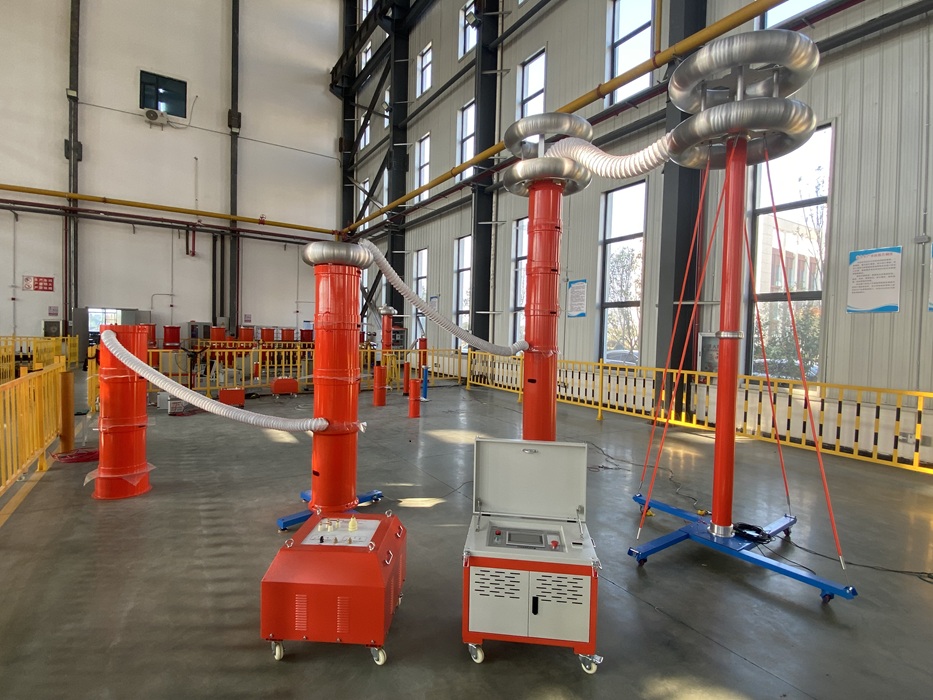
Series resonant systems solve both problems at once. The weight savings alone can be dramatic — systems capable of testing at 150 kV can sometimes be transported in a standard SUV. More importantly, because the system operates at resonance, a fault during testing (a flashover, say) causes the circuit to detune automatically. The fault current drops almost immediately, which means less damage to the equipment under test compared to what a transformer-based system would deliver.
55ef67a3be081c7acdfca35713653089.jpg

## A Note on Frequency
One thing that surprises some engineers new to this equipment: the test frequency doesn't have to be exactly 50 or 60 Hz. IEC standards like IEC 60840 and IEC 62067 specifically permit testing at any frequency between 20 and 300 Hz. This flexibility is what makes variable frequency resonant testing so practical — the system finds the frequency that creates resonance with whatever load is connected, rather than forcing the load to match a fixed frequency.
## Real-World Applications
Series frequency AC resonant test systems are used across a remarkably wide range of applications:
- **XLPE cable commissioning**: After a new underground cable is installed, it must pass a withstand voltage test before being energized. Resonant systems handle this routinely, even for cables several kilometers long.
- **Transformer factory testing**: Large power transformers often have very high capacitance in their windings. Resonant test systems allow manufacturers to perform required dielectric tests efficiently.
- **GIS maintenance**: Gas-insulated switchgear contains multiple insulating components. On-site resonant testing lets maintenance teams verify insulation integrity without dismantling substation equipment.
If you're evaluating test equipment for any of these use cases, understanding the resonant principle is the first step toward making a good purchasing or specification decision.


+8618330222305 +8618330222305 sales08@bdhuazheng.com 0086-18330222305 Julia Jin-huazheng
