Here are a few often-overlooked practical details when using a tan delta tester on transformer-type equipment, based on field experience.
## 1. Pre-Test Preparation: Don’t Skip the "Cleaning" Step
Equipment must be de-energized, isolated, and fully discharged. But many people overlook this: all exposed insulators and test points should be cleaned to remove dust and moisture. Test leads and cables must stay dry and in good condition—otherwise surface leakage currents will affect the readings and tan δ will read high.
For transformer bushings, caps on other phases should be tightened and grounded; only the phase under test should be open. These seemingly minor steps have a big impact on the accuracy of transformer insulation tests, cable diagnostics, and substation commissioning checks.
## 2. Wiring and Grounding: Safety and Accuracy Depend on It
Connect the HV lead to the main terminal and the feedback lead to the tan delta test point or test tap on the equipment. Both the tester and the test object must be reliably grounded—this matters for personnel safety and for reducing interference and improving measurement stability.
Some equipment (e.g., 220 kV CVT) has grounded busbars, so you can’t disconnect for normal forward wiring. In that case, choose a dielectric loss tester with "reverse wiring low-voltage shielding." You can perform 10 kV reverse wiring dielectric loss measurement on C11 without changing the existing wiring.
## 3. Step Voltage and Mode Selection
Apply voltage in steps according to equipment rating (e.g., 2 kV, 5 kV, 10 kV) and record tan δ and capacitance at each level. A well-insulated system should show stable tan δ across voltage levels; a significant increase with voltage often indicates insulation defects.
Choose the right test mode:
- **UST (Ungrounded Specimen Test)**: For ungrounded components
- **GST (Grounded Specimen Test)**: For grounded systems such as transformer windings
- **GSTg (Guarded GST)**: To eliminate stray capacitance effects
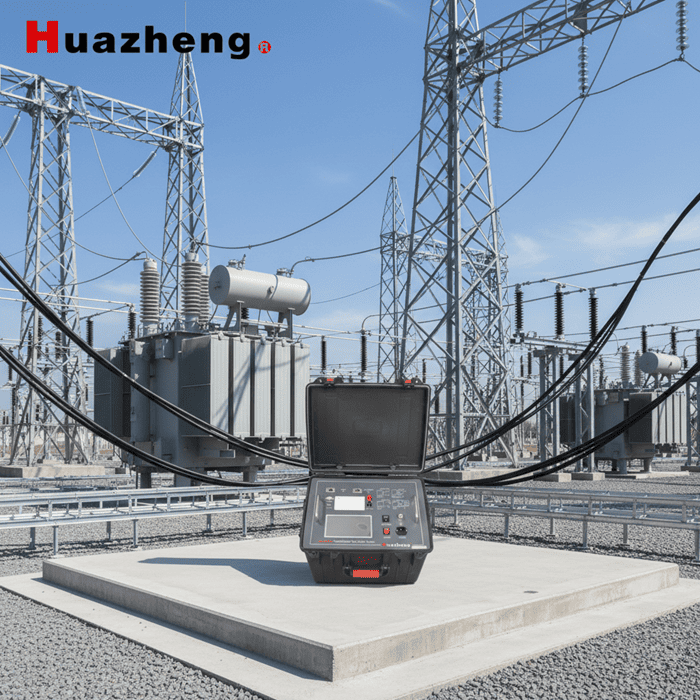
Modern dielectric loss testers typically use frequency conversion (e.g., 45 Hz/55 Hz dual frequency), FFT digital filtering, and microcontroller control for automatic frequency conversion, A/D conversion, and computation. They offer strong anti-interference, fast testing, and high accuracy. Some models support 40–70 Hz single or dual frequency and can work with external HV sources such as series resonance for high-capacity, high-voltage dielectric loss tests.
## 4. Interpreting Results and Next Steps
Lower tan δ generally indicates better insulation; consistently high values across voltage levels suggest moisture, contamination, or aging. Compare results with historical data or manufacturer specifications for trend analysis.
If measurements are abnormal, consider:
- Re-cleaning test points and insulators
- Checking test leads for moisture or damage
- For oil-filled equipment, checking oil moisture and performing oil filtration or drying if needed
- Additional diagnostics such as insulation resistance and partial discharge testing
Important: Dielectric loss testing must be done on de-energized equipment. Never apply voltage to energized equipment. The tester should have grounding protection (no normal operation or HV output when not grounded or poorly grounded), overcurrent protection, and shock protection to cut off HV promptly on short circuit or breakdown and protect personnel and equipment.
## Additional Features to Look For When Selecting Equipment
- **CVT self-excitation**: Supports CVT self-excitation tests with four protection limits (HV/current and LV/current)
- **C1, C2, and total capacitance and tgδ**: Automatically tests CVT C1 and C2 capacitance and dielectric loss, plus overall parameters
- **Oil dielectric loss**: With sufficient accuracy (e.g., tgδ resolution 0.001%), a standard oil cup and dedicated test leads allow insulation oil dielectric loss measurement
- **AC withstand**: Convenient for PT/CT secondary or 400 V low-voltage system withstand tests
- **Data and reporting**: Calendar, large-capacity storage, thermal printer, and computer interface for integration into a comprehensive HV test vehicle for measurement, data processing, and report output
 Phone: +8618330222305
 Email: sales08@bdhuazheng.com


![[sort:name]](/static/upload/image/20231109/1699520298738135.jpg)
 +8618330222305
 +8618330222305
 sales08@bdhuazheng.com
 0086-18330222305
 Julia Jin-huazheng
